


Temples and the State in India: A Historical Overview


This is the first of a new comprehensive series on Hindu Temples, their conception, history, heritage and legacy authored by M.D. Srinivas.
Introduction
India indeed is a land of temples. Indian civilisation comprehends the entire creation to be a manifestation of the divine. It also understands that the Paramatma can manifest in the world as avatara for the establishment of dharma from time to time. The places associated with the avataras as also the holy rivers, mountains, forests and other places sanctified by the presence of great rishis, bhaktas, and acharyas, are the great tirtha-kshetras, places which sanctify everyone. Further the Paramatma, out of infinite mercy for all beings, has made Himself accessible as archa vigraha, worshippable deity in various temples. This archa murthy can be either svayambhu, self-manifest or consecrated by great saints, devotees or acharyas.
Unlike a Church or Masjid, which are merely places of congregation and worship, the Temple in sanatana dharma, i.e. Devalaya, Devasthana, Devayatana or Koil, is the sacred palace of the Deity who is a Sovereign Person.

Sri Chandrasekharendra Saraswati
The role of temples in Indian civilisation has been explained by the Paramacharya of Kanchi Kamakoti Pitham, Sri Chandrasekharendra Saraswati Swamigal in an interview in 1959:1
Our temples are not organised as places for meditation, nor for congregational worship. The purpose of a temple is different. We enjoy the goods of life, such as house, food clothing, ornaments, music, dance, etc. We pay a tribute in the form of taxes to the King – now the Government – for making it possible for us to enjoy them by giving us their protection. The King Protector is provided with a palace and other paraphernalia of royalty. Even as we render homage to the kings for the enjoyment of these things, we are bound to tender our gratitude to God who has primarily given us the good things of life. We offer a part of these good things as a token of our gratitude to Him in the temple. We first offer to Him all that he has given to us, in the shape of food, clothing, jewels, music, flowers, lights, incense, and so on with the grateful consciousness that they are His gifts to us; and we receive them back from Him as His prasada. The temple is the place where these offerings are made on behalf of the collective community where it is situated. Even if people do not go to the temple, it is enough that these offerings are made to God on behalf of the community. The duty of the people at the place is to see that these offerings are made in a proper manner. There have been people who would not take a day’s meal till the temple bell announced that the offering to God of food for the day had been made. Then only do they take their meal as God’s prasada.
[contextly_sidebar id=”yEEEvuFCDW4l42EpLIAf6vraG28KkeLG”]
In another context, the Paramacharya has also noted that:2
If Hinduism has survived so long it must be due to some quality unique to it, something that gives it support and keeps it going. No other religion is known to have lasted so long. When I think of our religion I am reminded of our temples. They are not kept as clean as the churches or mosques…. Our sanctuaries are different because they are built of granite. Their foundations laid thousands of years ago still remain sturdy. … These temples still stand as great monuments to our civilization in spite of our neglect of them and our indifference. It is not easy to pull them down. Perhaps it is more difficult to demolish these edifices than it must have been to build them. Our religion, to repeat, is like these temples. It is being supported by something that we do not seem to know, something that is not present in other faiths… This something is varnashrama dharma.
The large number of temples in India:
Around 1820, when the British Government asked the collectors in various districts of the Madras Presidency to report on the number of religious institutions in their districts and their condition, it was reported that the twenty districts of the Presidency had over one lakh temples, chatrams and mathams. 3 Most of the districts were reported to have about 300 to 400 major temples.

Adi Kumbeshwara temple – Kumbakonam
The Government at Madras reported in 1833 that 7,600 temples were directly administered by the Government, and that may be taken as the number of major temples in the Madras Presidency at that time.
We obtain similar estimates if we consider more contemporary reports on the number of temples in different states. The 2005-6 budget report of the Government of Tamil Nadu notes that there are 38, 409 Hindu and Jain religious institutions under its management. The Andhra Pradesh Endowment Department has 33,575 religious and charitable establishments under its management. There are similarly large numbers of temples under government management in several states.
There is another way of estimating the number of temples, by considering the number of localities. It is common knowledge that every locality in India has at least one temple, often several. From ancient times, the classical texts of India have enjoined that one should not stay in a place which is not sanctified by the presence of a deity.

Kashi
The ancient great cities of Ayodhya, Mathura, Haridwar, Kasi, Kanchi and Ujjayani had (and most of them continue to have) several thousands of temples.
We can have some idea of how many temples there were in an average Indian locality in the eighteenth century by using the data of the survey of over 2000 villages in the Chengalpattu region around Madras, conducted by the British during 1767-1774.
The original Tamil records of the survey list the name, location and area of every temple in a locality. Unfortunately the data is not available for all the villages. In the available data, we do come across localities like Perunagar, near Kanchipuram, which had 33 temples. We find that each locality had four to five temples on an average.4
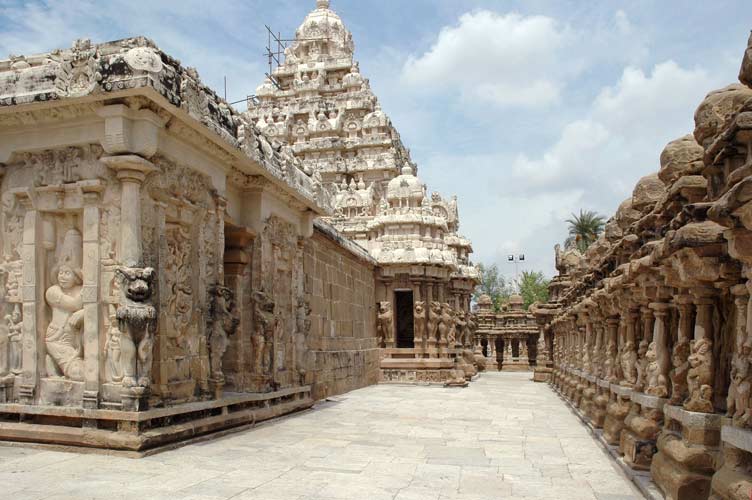
Though there would be enormous regional and sub-regional variations, it would be perhaps not too wrong if we estimate that on the average a locality in India would have four or five temples. And that would place the number of temples in the country to be more than two millions.
According to the 2001 census5 there are about 2.40 million “Census houses” which are classed as “places of worship” in the country. In 1991 this number was only 1.78 million and there has been a growth of 34.5% in the number of such places. It is not clear what the above growth represents. The census does not give the number of Temples, Churches, Mosques etc., separately.6
To be continued.
1 V.Raghavan, The Jagadguru, Madras 1965, p.48-9. Raghaven has reproduced the version of the interviewer, Arthur Koestler, as he published it in The Lotus and the Robot, London, 1960, p.54-63. Koestler says that he brought up the issue of “din and noise in Indian temples.” He then wanted to know whether this was the “reason why Indians with a meditative disposition had to resort to the solitude of the mountains or bury themselves in lonely caves.” The Paramacharya begins his answer by saying, “The case is just the reverse. Because solitude and a secluded spot have been prescribed from the oldest times, for contemplation, the temples do not have to serve that purpose.” The Acharya then goes on to explain the role of temples in Indian civilisation.
2 Hindu Dharma : The Universal way of Life, Bharatiya Vidya Bhavan, Mumbai 1995, p.660
3 Incidentally the number of Roman Catholic Churches in 1842 in the Madras Presidency was reported to be 847, of which 204 were in Madras city, 253 in the district of Madurai and 190 in Thanjavur.
4 It may be noted that a survey conducted by the Centre for Policy Studies in 1995, in about a hundred localities of the Chengalpattu district, found that the total number of temples had actually increased from what was recorded in the 1770 survey by more than 30%.
5 Census of India 2001, Tables on Houses, Household Amenities and Assets, H-1: Census Houses and the uses to which they are put.
6 According to a Christian missionary source, there were about 100,000 churches in India in 1987 which number has gone up to 350,000 by 2002 (http://www.mnnonline.org/article/5282) . Another source claims: “The number of churches in India has grown from 150,000, 20 years ago to some 400,000 today. That vast expansion means that there are more churches in India today than in the United States of America.” (Martin Robinson & Dwight Smith, Invading Secular Space: Strategies for Tomorrow’s Church , Monarch 2003, p.204). Incidentally the number of churches in the United States of America is estimated around 350,000. Islamic sources estimate the number of waqf properties in India to be around 300,000 in number. (Awkaf Experiences in South Asia, edited by Khalid Rashid, Indian Institute of Objective Studies 2002, page 124). However, it is not clear whether this gives any reasonable estimate of the number of Masjids and Dargahs in India.

Dharmic Temples and the Secular “Hindoo” State, you mean?
“Hindu” is not a religion. It is is an agglomerations of religions. It was a defunct nationality. It is now a legal fiction exploited by the Indian State for the benefit of the secular, the god less and Non Hindoos. Nearly every heritage temple in India used to represent a unique religion, and culture going back thousands of years. All these religions were held together by Aryan-Brahmin law, the Dharma.
There was no such thing as “Hindus” outside of the Indus Valley even a 1,000 years ago. “Hindu” was a term coined by the Persians to describe their co-coreligionists during their Vedai period (before their Avesthan-Zoroastrain Period) who lived in the Indus Valley i.e. present day Pakistan. The term was used by Moslem invaders to describe all natives who were not Moslem and was resurrected as a “religion” by the British when they began their pogrom to erase the Brahmins and the People of Dharma who adhered to Aryan Brahmin Law after the Sepoy Mutiny to put an end to all resistance to alien ideologies, cultures, religions and laws..
With the eradication of the traditional hereditary priesthood and law givers, (Brahmins) by the British since 1857 and their Pangolin* stooges since 1921 and with the confiscation of Temples, Treasure, Lands, Water Bodies, Forests, Commonwealth and Traditional Schools throughout British India in 1923, and followed through by the Cambridge, Columbia, Elphinstone, Presidency, St Stephen’s, Loyola, Madras Christian, Oxford and otherwise brain washed WOGs of the Indian Republic who turned the People of Dharma into third class citizens with their 1949 Constitution and confiscated their temples, treasure, water bodies, lands, forests, commonwealth and educational facilities in what was left of India, including former princely states in 1959, India was confirmed as an anti-secular, non democracy. This is what it is today, with a Constitution that has enshrined inequality under law, exceptions to the rule of law, and the Many Nations theory to condemn India to a perpetual state of low intensity civil war in which the preferred Politician-Bureaucrat-Judge-Police-Journalist-Crony neo kleptocracy, constructed mostly from those certified to be congenitally backward, or alien faiths and beliefs may loot, plunder and rape with impunity.
India’s erudition, arithmetic, integrity, culture and conscience challenged “secular” judiciary are the ultimate arbiters of what “Hinduism” is or is not and what temples may or may not do.
*Note: PANGOLIN: An enemy of India who believes in inequality under law, exceptions to the rule of law and persecution of some for the benefit of others. At present, the sole purpose of the Indian Republic, Constitutional or otherwise, is to pamper and provide for certain constitutionally preferred sections of society who the British found useful to hold and exploit India at the cost of those who the British hated and persecuted. The Pangolin is a creature that is unique to India and feeds on ants that are known in nature to be industrious and hard working if not quite as fruitful as bees who flee to better climes. (PANGOLIN is an acronym for the Periyar-Ambedkar-Nehru-Gandhi-Other (alien) Religions-Communist Consensus that usurped the British Mantle and has worn it with elan to loot, plunder, and rape India since 1921 and re write History and laws to their exclusive benefit since 1947)
Compelling Read. Articulation of many of my own views and concerns. Inspiring.
[…] http://indiafacts.co.in/temples-and-the-state-in-india-a-historical-overview/ […]
Good to see Dr.M.D.Srinivasji here.Waiting for the rest of the series of articles.Hope it also covers the largely Scientific nature of Hindu Temples, instead of political/ideological analysis.Thanks.