


Analysing the Quran through a Dharmic Perspective: Introduction


This essay is the first part of a series that analyses the Quran using a Dharmic perspective. It is a translation of the Bengali booklet titled “Allah Ke” (Who is Allah?) published in the early 1930s, authored by Swami Satyananda Saraswati (1900—1990), founder of Shaktivada.
For the translation of the Quranic verses, Muhammad Marmaduke Pickthall’s English rendering of the Quran has been used. The translator’s notes, comments and explanations are inserted in square brackets throughout the article. Moreover, for some of the non-translatable Indic words, a glossary at the end of the article.
We have no knowledge of the Arabic language. We have relied upon Bengali, Hindi and English sources for writing this exposition. Even then, we have found a lot of differences across various sources. Therefore, we have kept the quoted citations in this exposition as much as it could be found in the work The Light of Truth [Satyartha Prakasha by Swami Dayananada Saraswati].
Mohammad Akram Khan [journalist, politician and Islamic scholar who translated Quran into Bengali] could not use the commonly used philosophical words, Ishvara or Brahman (Omnipresent God), of Bengali as a synonym for Allah in his translation. No doubt, it reveals his learning. We have also retained the word “Allah” here because the philosophy found in the Quran, invokes the characters like Yama, Lord of Death, found in the Hindu Puranas. Allah judges over the dead souls. It is the job of Yama who maintains an account-book of all the activities undertaken by human beings in their life on earth. Does Allah too maintain an account book like that of Chitragupta, the clerk of Yama (surah I al-Fatiha, verse 4; surah XIX Maryam verse 79)?
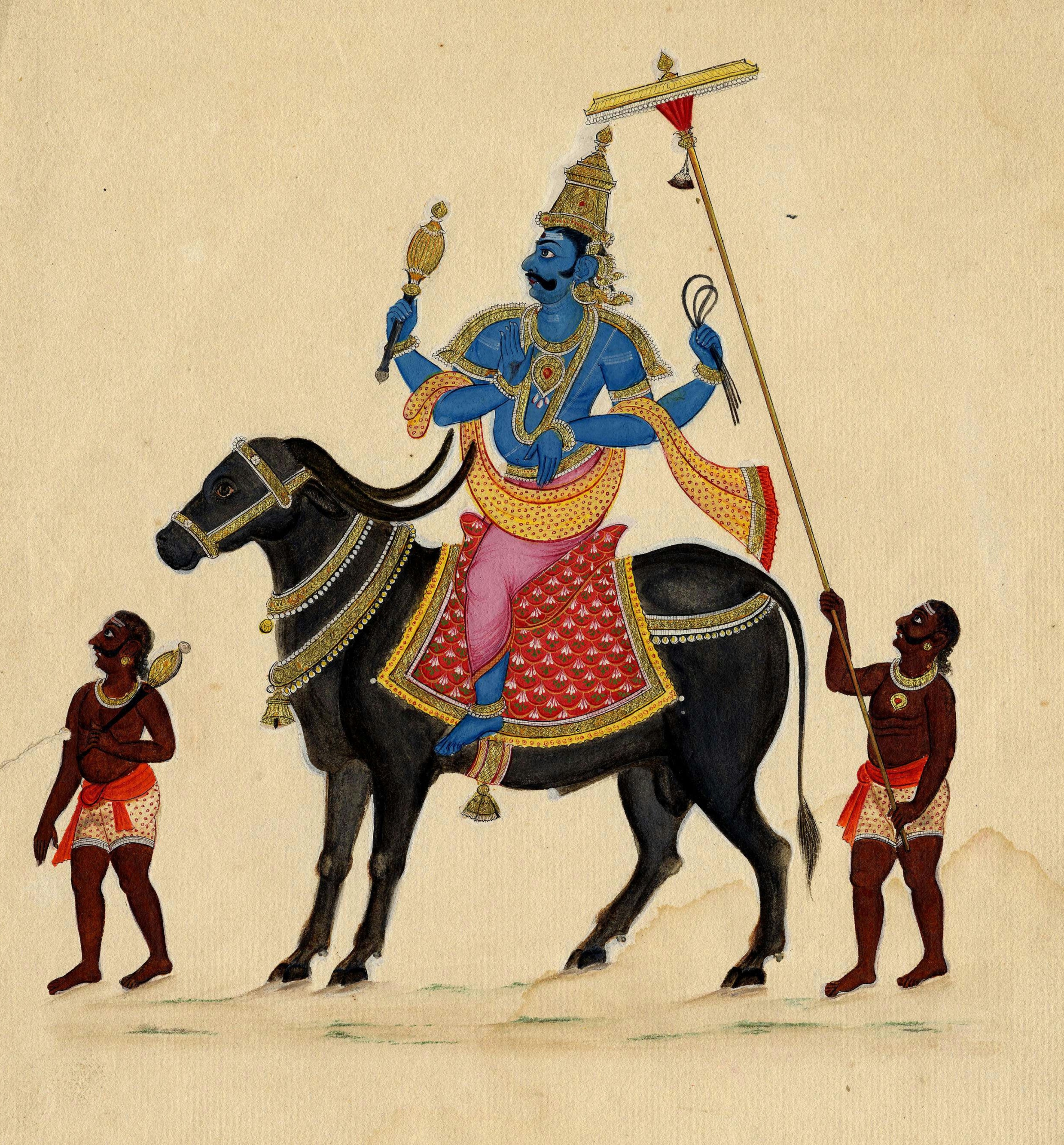
Lord Yama: A Painting
Allah erected the structure of Adam akin to His own structure [Sahih Muslim, 032: 6325; Sahih Bukhari, chapter 82, Number 5873]. This also proves that Allah is not a Omnipresent Entity like Ishvara or Brahman as also implied in surah XIII ar-Ra’d, verse 11. He prescribes an endless Paradise for those who are believers in the Quran, the Quayamat (The Judgment Day), Allah, and Rasul [The Prophet], and for the non-believers, an endless Hell (dujakh).
The judgment of Yama is far more rational than this, who awards temporary heaven or hell for all sorts of good and bad, justice and injustice, truth and lies, donation and stealing, virtues and vices. But, there is hardly any such rationale for any of the words of the Quran.
One can perpetrate atrocities believing in Allah. Again, what else is the provision other than Hell for many truthful, dedicated, broad-minded and generous people who do not believe in Allah? The precise lesson the Quran imparted to us, is that it is a book for revolution.
Those who have read the thoughts of Karl Marx and Lenin, may read this too; they will understand everything. The greatest achievement of this revolution is that it cheated both the believers and the opponents. The believers did not find any philosophical idea or food for thought in this book, whereas the opponent was ignorant about the nature of this revolution.
Hundreds of verses mention punishments if somebody expresses doubts about the truth behind Allah, the Quayamat, the Quran, the Rasul etc. The opponents knew that it was merely an irrational doctrine of faith. However, intelligent persons on its own side knew very well that it is a plan to conquer lands. In this way, by controlling a group of uneducated people, this revolution became successful. Lenin too achieved the success of his revolution in this very way.
[contextly_sidebar id=”WzZOaNkDhKg0vigbhmbpopWyCYG6QVL0″]
The Quran instigates its followers to go to war against murti-worship. In the writings of Md. Akram Khan too, this instigation is observed. The Hindus know very well that Muslims do not worship any idol. They also know that Ishvara is one and all-inclusive. They know it very well that Ishvara (God) is Omnipresent, whose activities are not un-philosophical and chimerical. Hindus create murtis to help develop an understanding of different stages of experiential realisation of knowledge.
We can now turn to examine a few verses of the Quran:
1) The Quran is only for the nation of Arabs. (Surah XLI Ha Mim Sajdah, verse 44)
- Different great men have come for different nations. (Surah X Jonah, verse 47)
- The Books are also different for different nations.
In the same spirit, we can say that
1) The Quran is not acceptable in the land of Hindus.
2) There is no need for the Quran and Muhammad in the land of Sri Krishna, Sri Rama and Sri Buddha.
3) The Vedas will remain the guidance for dharma in our land.
In the Quran, we can see that Allah erected a statue, the structure of Adam. He granted life to that statue and asked His angels to prostrate before the statue. All except Iblish obeyed Him. For this disobedience, Allah became furious and kicked Iblish out, calling him Satan. From this, it appears that Allah Himself teaches idol-worship or “but-parasti” (the term for idol-worship in Islamic Theology). However, this kind of idol-worship is a piece of whimsical action without any basis of science.
Even if the Hindus worship Ishvara with a murti [a manifestation of divinity], it is not inconsistent with Hindu scriptures and philosophy. “All is nothing but Brahman” – earth, stones, trees, creatures, animals, human beings, the welkin, wind, fire, water, all are various forms of Brahman. Thus, even if we accept that Hindus worship murtis, still they worship Brahman.
But, what is the philosophical rationale behind bowing down on the earth with tremendous respect in places like markets, roads, fields, cemeteries, floors of houses etc.?
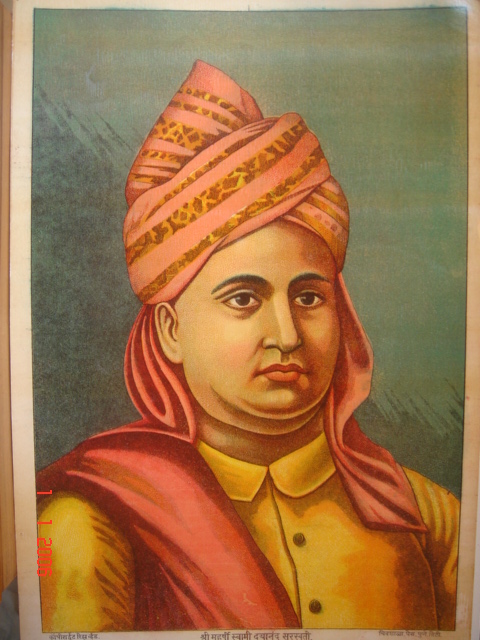
Swami Dayananda Saraswati
Nowadays, Muslim activists are very much active against the book, Satyartha Prakasha. If Quran-ism can convert a section of our population into Mecca-ists by shattering their culture and dharma, if it can break murtis after murtis and can erect mosques after mosques by shattering sacred temples of Hindus, in the name of putting an end to “but-parasti” [idol-worship] without caring a fig about philosophy and rationality, then why can sannyasis not refute Mecca-ism as un-philosophical and irrational?
We endorse the Arya Samaj, because this powerful dharma which the Hindus have created abandoning the recourse of murti, has enhanced the vitality of the Hindus. If the recourse of murti is abominable, why don’t Muslims not join the Arya Sama? If there is no intention of revolution, we do not see any necessity to hold on to irrationality and un-philosophical beliefs in the name of dharma.
There is absolutely no possibility of making another revolution happen by this thinking. The British, experts in politics, have taken up the policy of bribing Muslims by all possible means in order to set up a permanent problem of impending revolution. And the emotional (bhavavadi) Hindu leadership is on their way to walk into the trap in their hurry to attain self-governance [swaraj] without much sacrifice. Therefore, it is undeniable that the problem has become quite complicated for us.
We bring out this booklet, with citations from the Quran, for the sake of the Hindus. The Muslim society of this land has been formed by breaking the Hindu society. Even now, Hindus are being broken in hundreds of ways. Hindus have been being ceaselessly persecuted since the time of arrival of Islam in India. The purpose of this booklet is to assess the role of Quran-ism with this immorality and also to make sure that Hindus do not let their guard down by being misled by the false propaganda created by the believers of the “equality and harmony of all religions” [Sarva-dharma-Samanvaya].
We made our commentary with due caution so that it does not hurt others’ faith. If any problem still remains, we will rectify on being informed.
This booklet will especially be helpful for the descendants of Hindus who want to come back to their ancient dharma.

I was born into a Muslim family and now, while I don’t technically ascribe to any faith, my practices and go-to for knowledge most closely resemble Hinduism by a long shot. I practice Kriya Yoga, read the Baghavada Gita basically every day, and am very involved with advaita philosphy (Sri Ramana Maharshi being my favorite guru this matter.) With this in consideration:
I appreciate you taking the time to write the article. The logic in your arguments sounds great, but the issue I see with many syllogisms or line of thought is that the assumptions you made were, as I see it, not correct. Therefore, if the foundation of the conclusion is not true, the conclusion may not also be true. Let me share an example of my opinion:
In Islam, but-parasti is the act of worshiping something that is not “God” (equivalent of consciousness in Hinduism) as if it was God. But in your article, you said how Muslims must, by nature, be but-parasts because of the role Adam plays in Islam. If your definition of but-parast was the same as mine, then this is not true, because obviously, this would be a “sin”. Rather, in Islam, one is meant to worship the *ideals* of God, or Allah, or the 99 names of Allah, which happened to be most prevalent in Adam, but not worshipping Adam in and of itself.
Now here is the interesting part as I see it, that gives me comic relief to oh-so-serious people wanting to point that one religion is wrong, and their’s is correct. In the case of Hinduism and Islam, *both* faiths are worshiping the *states of mind*, or, *the way of being-ness*, or *”God”* all together; what is Ganesha representing, what is Vishnu representing, what is Krishna reprseting? Even Paramhansa Yogananda says in “God Talks With Arjuna”, Krishna was not God himself, only an incarnation of God. Hinduism is worshiping states of mind that will expand the mind, and so does Islam.
At the end of the day, I see these two faiths doing exactly the same thing, and in the ultimate sense of the term, I see them being exactly the same.
Are you refuting the following? :
1. Allah erected a statue, the structure of Adam.
2. Allah granted life to that statue
3. Allah asked His angels to prostrate before the statue.
If the angels did as asked then it is nothing but “but-parasti” !!!
Ram Swarup: Hindu View of Christianity & Islam
http://www.scribd.com/doc/19106059/Ram-Swarup-Hindu-View-of-Christianity-Islam
http://dangerofislaminindia.blogspot.com/
The main problem in your analysis is the obvious lack of knowledge or authority over the subject matter you are trying to examine. If you do not believe in Allah or his prophets but you are genuinely a good person as described above you will not go to hell. If you lived a completely sinful life but did one really good deed , Allah said that this one good deed could weigh more than all of your sins. For instance Allah said if an individual saves a life , it’s like saving all humanity , but if he takes out a life (kill) it’s like killing all humanity.
I am a Muslim and while I do not agree with any of what you have said I am not going to insult you. I just wish you could have been more objective in your assessment. I majored in Philosophy at school and my American nonmuslim professor would strongly disagree with your assessment too. Obviously you have made your assessment and written out your conclusions too prior to reading or learning about the Quran. It’s obvious in your writing.
You wrote: “Allah said if an individual saves a life, it’s like saving all humanity , but if he takes out a life (kill) it’s like killing all humanity”.
Anyone who has studied the Qur’an knows that such a verse doesn’t exist in the Qur’an. This is the typical lie Muslims are urged to propagate in order to promote their religion (Taquiya). And if you are a little knowledgeable (after majoring in Philosophy) you should have quoted verse 32 of Surat Al- Ma’idah (5:32)! Here is what it and the next verse (5:33) actually say!
5:32 On that account: We ordained *for the Children of Israel* that if any one slew a person – *unless it be for murder or for spreading mischief in the land* – it would be as if he slew the whole people: and if any one saved a life, it would be as if he saved the life of the whole people. Then although there came to them Our messengers with clear signs, yet, even after that, many of them continued to commit excesses in the land.
Verse (Q. 5:32) was plagiarized from the Talmud. Let us read a translation of Babylonian Talmud: Tractate Sanhedrin, translated by Michael L. Rodkinson – Book 8: Section Jurisprudence (Damages), [Bostin, The Talmud Society, 1918] – Tract Sanhedrin, page 1747 https://www.jewishvirtuallibrary.org/jsource/Judaism/FullTalmud.pdf:
“Therefore the man was created singly, to teach that he who destroys one soul of a human being, the Scripture considers him as if he should destroy a whole world, and him who saves one soul of Israel, the Scripture considers him as if he should save a whole World.”
Let us also add the Mishnah, translated from the Hebrew with introduction and brief explanatory notes, [Oxford University Press, 1933], by Herbert Danby,D.D., page388:
“Therefore but a single man was created in the World, to teach that if any man has caused a single soul to perish from Israel Scripture imputes it to him as though he had caused a whole world to perish; and if any man saves alive a single soul from Israel scripture imputes it to him as though he had saved alive a whole world. …”
So it is clear where Muhammad lifted these ideas from as he did many other ideas (with errors) to fill almost a third of Islamic scripture. Despite this plagiary everything still sounds good, magnanimous and humane, until one understands what the word “mischief” was supposed to mean, which is given in the very next verse of the Quran, equated to “waging war against Allah and His Messenger” and applies to someone who simply refuses to accept Islam. Here it is:
5:33 The punishment of those who wage war against Allah and His Messenger, and strive with might and main for mischief through the land is: *execution, or crucifixion, or the cutting off of hands and feet from opposite sides, or exile from the land:* that is their disgrace in this world, and a heavy punishment is theirs in the Hereafter;
It beats me how a Muslim who has majored in Philosophy could glorify 5:32-33 as a high ideal of the Quranic teaching? In Quran, beheading, crucifixion, killing and torture are common place punishments reserved for Jews and non-believers, zealously followed by ISIS.
None of what you said is quoted in the Quran. I am surprised you did not bother to quote the Chapter and verse in the Quran to buttress your argument. Btw, on this “saving of one life .. and killing of one life” … her is the verse:
5:32 that if any one slew a person – *unless it be for murder or for spreading mischief in the land* – it would be as if he slew the whole people: and if any one saved a life, it would be as if he saved the life of the whole people. Then although there came to them Our On that account: We ordained *for the Children of Israel* messengers with clear signs, yet, even after that, many of them continued to commit excesses in the land.
Verse (Q. 5:32) was plagiarized from the Jewish Talmud. Let us read a translation of Babylonian Talmud: Tractate Sanhedrin, translated by Michael L. Rodkinson – Book 8: Section Jurisprudence (Damages), [Bostin, The Talmud Society, 1918] – Tract Sanhedrin, page 1747 https://www.jewishvirtuallibrary.org/jsource/Judaism/FullTalmud.pdf:
“Therefore the man was created singly, to teach that he who destroys one soul of a human being, the Scripture considers him as if he should destroy a whole world, and him who saves one soul of Israel, the Scripture considers him as if he should save a whole World.”
Let us also add the Mishnah, translated from the Hebrew with introduction and brief explanatory notes, [Oxford University Press, 1933], by Herbert Danby,D.D., page388:
“Therefore but a single man was created in the World, to teach that if any man has caused a single soul to perish from Israel Scripture imputes it to him as though he had caused a whole world to perish; and if any man saves alive a single soul from Israel scripture imputes it to him as though he had saved alive a whole world. …”
So it is clear where Muhammad lifted these ideas from as he did many other ideas (with errors) to fill almost a third of Islamic scripture. Despite this plagiary everything still sounds good, magnanimous and humane, until one understands what the word “mischief” was supposed to mean, which is given in the very next verse, equated to “waging war against Allah and His Messenger” and applies to someone who simply refuses to accept Islam. Here it is:
5:33 The punishment of those who wage war against Allah and His Messenger, and strive with might and main for mischief through the land is: *execution, or crucifixion, or the cutting off of hands and feet from opposite sides, or exile from the land:* that is their disgrace in this world, and a heavy punishment is theirs in the Hereafter;
How can any Muslim glorify 5:32-33 as a high ideal of the Quranic teaching? In Qur’an beheading, crucifixion, killing and torture are common place punishments reserved for Jews and non-believers zealously followed by ISIS today.
I have read ,while browsing a website about Swami Rama Tirtha,that he had told Maulvis that the first word of the Holy Quran is Ilm.As per the Arabic grammer,when L is placed between any vowel and consonent,then it’s pronounced O.Thus,Ilm is OM( Aum).I wonder how far true is this.
The concept of revolution,described above, fits partition history of India. On Aug 14 1946, Muslims were ready for revolution and civil-war. Jinnah’s call for ladke lenge pakistan (battle for pakistan) resulted in Great Calcutta Killing & Naokhali Genocide. In sharp contrast, Hindus were unprepared & their leader Mahatma Gandhi was no Abraham Lincoln.
I can see the value of writing article such as this. But ultimately it amounts to writing a lengthy essay analysing the difference between a piece of dogshit and a 500-carat diamond.
It’s testament to the sad fact that so many people cannot tell the difference between diamonds and crap.
Which is why scholars of yore did not engage in that exercise by recognizing the desert cult as a tradition deserving critique. They took it as a political enemy and defined their objective as erecting a dhArmic empire. Ex: Vidyaranya, Samartha Ramadas.
must read “Hindu View of Christianity & Islam” by Ram Swarup
http://www.scribd.com/doc/19106059/Ram-Swarup-Hindu-View-of-Christianity-Islam